


Above are two photos I took before we bought the house, with the previous owner's furnishings.
Here are some photos of the kitchen in our old house:
.jpg)
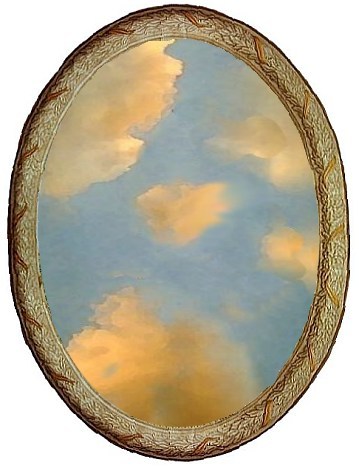
An overall shot of our former kitchen showing painted walls, cabinetry and ceiling. The idea was that you felt you were in a dilapidated French farm building (specifically, a dépendence of a mas provençal), with the beamed ceiling broken away in areas, revealing the sky, and wild herbs growing on the roof above. The cabinets above the countertops were painted like windows looking outside to fruits, vegetables, olive branches, etc., and the lower cabinets were painted to look like animal pens, housing pigs, a lamb, chickens & rabbits (all edible, bien sûr!)
(Photo by Nan & Monty Abbott)

Smooth walls were transformed into faux bumpy stone ones with paint. I also added trompe l'oeil postcards, business cards from France and a French recipe, just for pure fun. People used to run their hands over this wood post to see if the items were real...and just to tease people, the Van Gogh postcard WAS real!

One corner with Italian majolica plates and an old Venetian floor lamp

One corner with Italian majolica plates and an old Venetian floor lamp

The breakfast nook with French wheat-back chairs and French linens
(Photo by Jay Elliott)

Another view of the breakfast nook with my husband, Jack Dickerson's painting, Il Contidino, a portrait of an Italian farmer at the end of the day, waiting to share wine and bread with a friend. The table, covered in an Italian tablecloth, was set with Italian and French items. The silverware is French; the plates were from a visit we made to San Gimignano in Deruta pottery country, Italy; and the glasses were some we picked up on a trip to Biot in the South of France, near where I used to live - so many happy memories!

Another view of the breakfast nook with my husband, Jack Dickerson's painting, Il Contidino, a portrait of an Italian farmer at the end of the day, waiting to share wine and bread with a friend. The table, covered in an Italian tablecloth, was set with Italian and French items. The silverware is French; the plates were from a visit we made to San Gimignano in Deruta pottery country, Italy; and the glasses were some we picked up on a trip to Biot in the South of France, near where I used to live - so many happy memories!

Jack and I designed this dish rack in the breakfast nook, to hold some of our French, Italian & Portuguese plates. There's a Moroccan plate in there, too, from one of Jack's mother's voyages; a vintage carved wood German bread board; and an antique copper mold inherited from Jack's ancestors in Amsterdam.


These two photos (above & below) show the kitchen after years of use - rather worn out, but still charming.

The drawers above the animals all featured herbs. Note the chicken with a special plaque - "Poulets de Bresse". I also featured these fabulously delicious French chickens in my murals at PB Boulangerie Bistro. I wrote about them here.
The real door to the basement was painted to look like a door out to a French garden, with a pear tree and rows of lavender in full bloom.

Above the door was a Della Robbia plaque we had brought back from San Gimignano.

We hung real garlic to further trick the eye (what trompe l'oeil painting is all about.) I even had to nail the antique square nail into the door at a distinct angle, so that it would seem to be in the correct perspective!

The goose waddling around the corner of the door is a foie gras producing goose, famous in the Dordogne region of France. Again, this gourmet bird had a special place in my PB Boulangerie Bistro murals. I wrote about it here.

I took this photo as we were moving out. The shelves had been full of cookbooks. The grain sheaves depict wheat, barley, oats & rye. The quote, which continues around the top of the room, is from one of my favorite French cooks, Madame Lulu Peyraud, owner of Domaine Tempier vineyards in Provence. The quote is, "You know, my food is nothing but plain old cuisine de bonne femme [traditional housewife cooking]. What makes it different from restaurant cuisine or recipes in cookbooks, is that I am always cooking for someone I love." Jack painted the lettering.
Another quote on our woodwork, which has great memories and meaning for us, is this one by our friend, Patricia Wells: "What grows together, goes together." A prolific cookbook author, Patricia also teaches fun and informative French cooking classes in both Paris and Provence. We once took a week of Provençal cooking lessons from Patricia, and learned this quote during that week.
Notice my window valences, above, and then the very similar one, below, in Lulu's kitchen. Both are traditional, hand-block-printed cotton indiennes from Souleiado, in Provence.
Above is an absolutely charming photo of Lulu Peyraud with her dear friend, Alice Waters, photographed in Lulu's kitchen. For more about Alice Waters, see my posts here and here. Our Lulu quote came from the book, Lulu's Provençal Table, by Richard Olney, with a forward by Alice Waters.

Another picture of Lulu in her kitchen, shows the wonderful Souleiado border fabric in color. This border fabric, called La Grosse Rose, is available online here. Old French farmhouses often have a fabric valence like this one, to keep smoke and ash from going into the room, in case of a strong wind.
A third quote in the old kitchen was from Julia Child: "Life itself is the proper binge." Since Patricia Wells, Alice Waters, Lulu Peyraud and Julia Child are all culinary heroines of mine, I may have to include quotes from all of them in our new kitchen. Click here to read my post about a cooking class I once took with Julia Child.

The tiles used for backsplashes and stairway were ones we had purchased on our honeymoon in Portugal. The marble countertops were made of slabs that had been rescued from an old bank building in Boston.

Detail showing the gorgeous ochre marble, which Jack installed himself (very heavy!!)

Detail showing the gorgeous ochre marble, which Jack installed himself (very heavy!!)

I went out one day and came back to discover Jack installing leftover tiles on the stair risers - I just LOVE this! Our original island, which Jack also had built, was covered in these tiles, with the floral border all around. Unfortunately, that had to be sacrificed when we had the new kitchen built. The flooring was Portuguese cork - a lovely warm color and so soft to stand on.

The new island was covered in tumbled Botticino marble, which beautifully matched the marble countertops and our faux painted walls.
Better Homes & Gardens Christmas '03 (I will upload a better PDF, soon, I promise!)






 Posts
Posts


